
When Depression Makes School Feel Impossible: A Guide for Parents
Many parents worry when their child or teen suddenly struggles to keep up with school. You might see your child overwhelmed by homework, unable to focus, or even having trouble getting out of bed. This can be confusing and upsetting, especially if your child has always been responsible and motivated.
It’s important to know that these changes are rarely about laziness or lack of effort. Often, they are signs that your child’s brain and body are under too much stress. In my clinical work, I often see students who want to do well but feel unable to initiate or sustain effort. What can look like avoidance from the outside is, from the inside, a kind of shutdown. These patterns are frequently linked to depression, anxiety, trauma, or a combination of these.
What’s Happening in the Brain
When a child is anxious, their brain is often “turned up too high,” making it hard to relax or slow down. With depression, the brain can be “turned down too low,” especially in areas that support motivation, focus, and initiation. Sometimes, both patterns occur at once. A child may feel restless and worried, but also exhausted, foggy, or stuck.
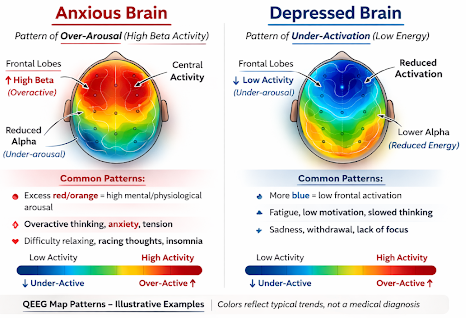
These patterns are not your child’s fault. They reflect a nervous system that is struggling to regulate itself. In many cases, what is affected is the brain’s capacity to organize action—what we might think of as the ability to get started, stay engaged, and follow through.
In my clinical work, I use QEEG (Quantitative EEG) to better understand these patterns. QEEG is a safe, non-invasive way of measuring how different parts of the brain are functioning in real time. It allows me to move beyond guesswork and observe patterns that are often associated with depression, anxiety, or trauma-related dysregulation.
The results appear as a color map: red areas show where the brain is more active than expected, blue areas show underactivity, and green reflects activity within a typical range. These maps help identify whether a child’s brain is overactive, underactive, or out of balance, and they guide more targeted, individualized treatment planning.
Why This Matters for School
When a child’s brain is under this kind of strain, schoolwork can feel overwhelming or even impossible. Your child might say, “I don’t know what’s wrong with me—I used to be able to do this.” They may sit at their desk for long periods, wanting to begin, but feeling blank, stuck, or depleted.

From a clinical perspective, this is often not a problem of willpower, but of access. The systems in the brain that support initiation and sustained effort are simply not coming online reliably. For children with trauma histories, this may also be compounded by chronic tension, poor sleep, or a persistent sense of internal unease.
From the outside, it can look like avoidance. On the inside, it often feels like paralysis—an inability to move forward despite genuine intention.
A Real-Life Example
I once worked with a student who had always been a high achiever. Suddenly, she couldn’t finish assignments or see her friends. She spent hours at her desk but couldn’t start her work. As she fell behind, her anxiety and sadness increased, and she began to question herself in ways that were painful and discouraging.
In our work together, we shifted the focus away from pushing harder and toward understanding what was happening internally—both emotionally and cognitively. As her experience made more sense to her, the cycle of self-criticism began to ease. With support, she took a temporary step back from school, focused on stabilizing her mood and restoring her sense of agency, and eventually returned with greater confidence and capacity.
When Is It Time to Step Back?
Sometimes, pushing through isn’t the answer. If your child could function as they used to, they would. A meaningful change in your child’s ability to manage school or daily life is usually a sign that something internal is not working as it should.
Continuing to apply pressure in these situations can unintentionally deepen a cycle of frustration, shame, and withdrawal. In contrast, recognizing the problem early and responding with appropriate support often leads to more effective and lasting recovery.

Signs your child may need help:
● Trouble focusing or finishing basic tasks
● Big changes in sleep, appetite, or energy
● Feeling anxious, numb, or overwhelmed most of the time
● Falling behind even when trying hard
● Seeming “shut down” or unable to cope
Taking a step back is not giving up. It is often a necessary step toward restoring functioning and well-being.
How Therapy Can Help
Therapy provides a structured, supportive space where your child can begin to understand what they are experiencing and why. In my work, I do not begin by focusing on productivity or performance. Instead, I focus on helping the child make sense of what is happening internally—emotionally, cognitively, and physiologically.

This often includes:
● Understanding the underlying causes of their distress
● Reducing cycles of avoidance, self-criticism, and overwhelm
● Supporting the nervous system in regaining balance
● Gradually restoring the ability to initiate and sustain effort
● Developing a realistic and supportive plan for returning to school
When appropriate, this work may also be informed by objective measures such as QEEG, which can help guide more targeted interventions, including neurofeedback.
Early support can make a significant difference. With the right approach, children can recover their sense of competence, rebuild confidence, and return to school in a way that feels manageable and sustainable.
Taking a step back can be the first step forward.
Begin Depression Therapy in Severna Park, MD
Therapy at Thinking Tree can help your child and your family thrive! If you or your child seem to be struggling or shares struggles that feel too big to handle alone, Thinking Tree Psychology is here to help. Whether you seek individual therapy or family therapy to address unique family dynamics, our Severna Park therapy office has skilled clinicians trained to provide individualized and collaborative support.
To start your therapy journey, follow these simple steps:
Meet with one of our caring clinicians
Start helping your child and family thrive
Other Services at Thinking Tree Psychology
We offer many services at Thinking Tree Psychology in Severna Park, MD. Our skilled therapists provide a wide range of mental health services to help your entire family thrive. For example, at Thinking Tree Psychology, we have clinicians who can offer psychoeducational testing, parenting support, anxiety treatment through therapy, therapy for chronic illness, and therapy for young adults. At this time, we are also offering telehealth psychology services as a convenient, safe way to attend therapy. Please visit our therapy overview page to learn more about additional therapy services. For other questions, please visit our FAQ page.

Dr. Glenn Horwitz is a licensed clinical psychologist with over 20 years of experience providing psychotherapy to children, adolescents, and adults. He works with youth and parents experiencing anxiety, mood concerns, trauma-related difficulties, executive functioning challenges, and life transitions. His therapeutic approach is thoughtful, collaborative, and individualized, helping clients build insight, resilience, and practical coping strategies. Dr. Horwitz utilizes both cognitive-behavioral and insight-oriented modalities, and integrates hands-on and engaging techniques into treatment such as sand-tray therapy, art therapy, mindfulness and meditation, and neurobiofeedback.